
A Canterbury Tale
Is that the most cliched title for writing about a trip to Canterbury?

In the medieval Christian world, one of the greatest ways you could show your piety was by undertaking a pilgrimage. While you may be familiar with the Islamic requirement to complete the pilgrimage to Mecca, Christianity has no equivalent demand. Yet, for most of Christianity's history, pious believers have felt drawn to visit holy sites. This impulse is not gone - how many Christians fervently desire to visit Jerusalem in order to see the places where Jesus lived and died? There is a powerful draw to these places, even if we can't quite provide a rational explanation for it.
Medieval Christians felt this impulse just as strongly, but in addition to certain holy places, they also made pilgrimage to the resting sites of holy relics and tombs. Medieval churches were overflowing with saints' bones, pieces of the true cross, and innumerable other holy items available for veneration. Over the centuries, some of these relics and churches developed an outsized reputation, and became focal points for pilgrim activity.
Many of you have likely heard of the Camino de Santiago, a medieval pilgrim path in northern Spain that has gained a renewed popularity in recent years. Santiago de Compostela, the town at the end of that route, supposedly housed the bones of St. James, and many miracles were reported at the cathedral where James was buried. Santiago de Compostela was one of the four major pilgrim sites in medieval Europe (not counting Israel, as it's outside of Europe): Santiago, Rome, Cologne, and Canterbury.
Canterbury Cathedral has been the site of a church since the 500s, when Augustine (not the one who wrote the Confessions) was sent by the Pope to help reestablish Christianity in pagan England. It was a major power center of the early Norman rulers in the 11th century, and has been the home to famous and influential thinkers. But Canterbury really took off as a pilgrimage site after the murder of Thomas Beckett in 1170.
I don't intend to go into the whole story of Beckett here, but the short version is that he was the Archbishop of Canterbury, and he clashed regularly with King Henry II. At one point, exasperated with Thomas, Henry was heard to say, "Won't somebody rid me of this troublesome priest!" Well, when you're a king you can't be saying those things if you don't mean them: four knights rode off to Canterbury and murdered Beckett on the King's behalf. The King at least claimed to be horrified and was seen begging Thomas' forgiveness in the cathedral.
In the time after Thomas' death, he was proclaimed a saint, and there were reports of miracles and healings at his tomb. A huge pilgrimage wave began, to the point where Canterbury became one of the most common pilgrimage sites, as already mentioned. The pilgrims who tell their amusing stories in Chaucer's Canterbury Tales are on their way to Thomas Beckett's tomb, about two centuries after Thomas' death.
This lengthy history lesson is an incredibly long way to introduce my actual topic for today, which is my own pilgrimage of sorts. Yesterday, I took the train from London in the morning through most of county Kent to the town of Canterbury. Upon alighting from the train, the first thing I saw was the ancient walls of the town. Canterbury retains some of the walls originally built by the Romans, then adapted to use by Norman and English kings down the centuries. Immediately I felt a bit displaced from the present, even coming from a city as steeped in history as London.
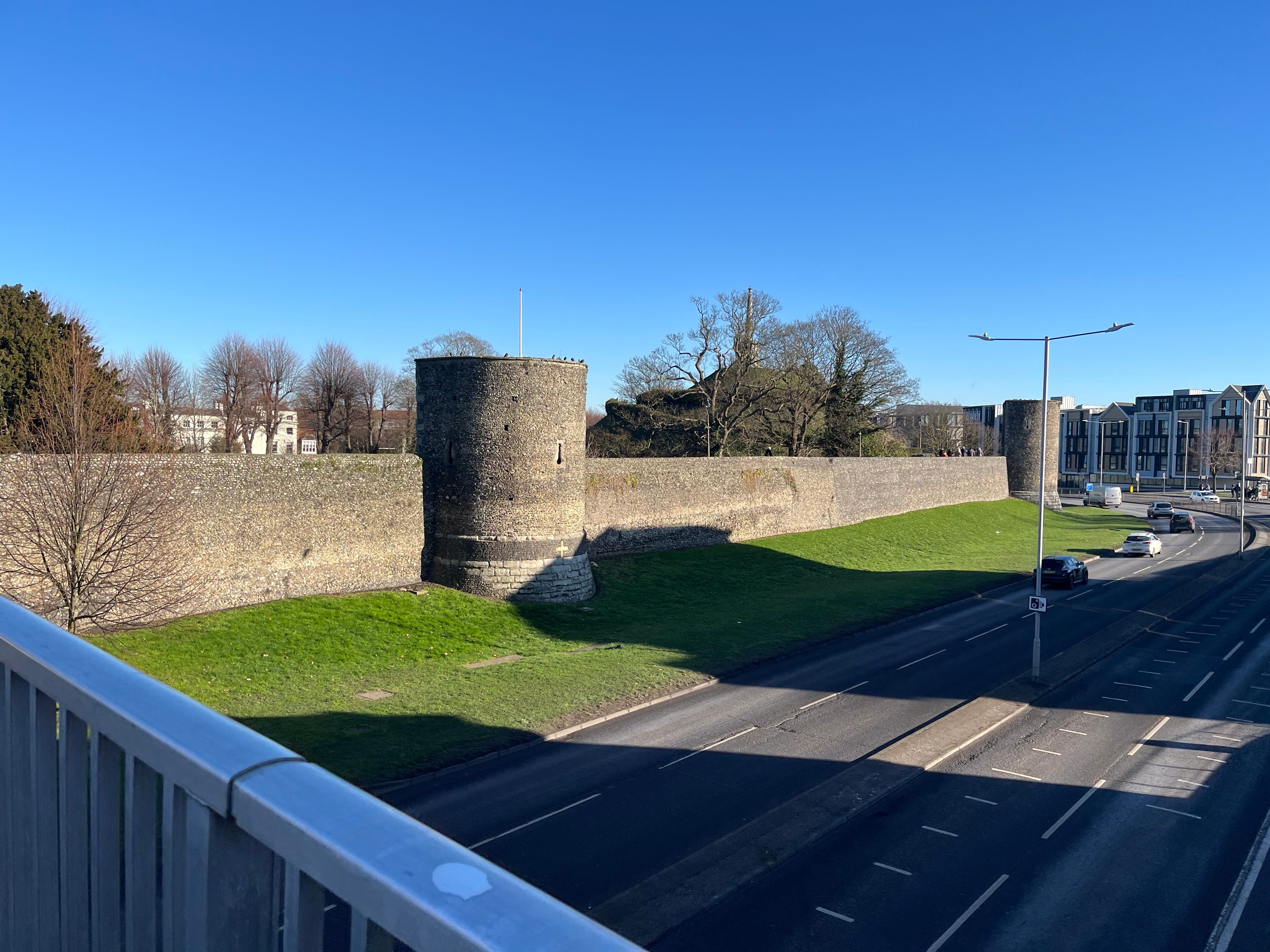
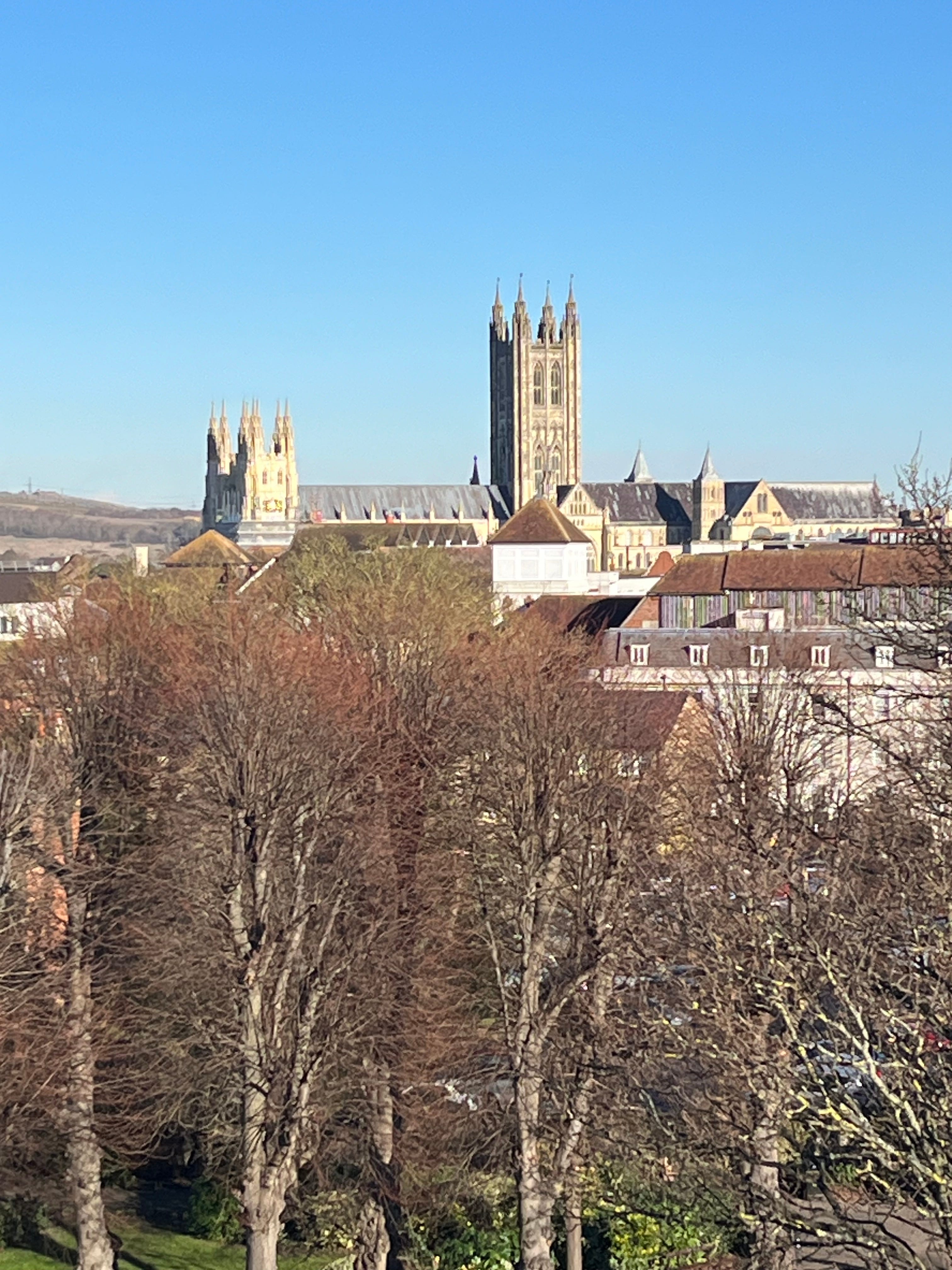
As I walked along the ancient wall, I noted a monument on a hill. It was an easy walk up, and from there, I got a beautiful view of the entire town, including the cathedral in the distance. Despite the hill being small, I felt as though I was at the tallest point of Canterbury (aside from the Cathedral towers). The wind was cold, but I paused to reflect on just how huge the cathedral was, how it stood out in comparison to the town around it.
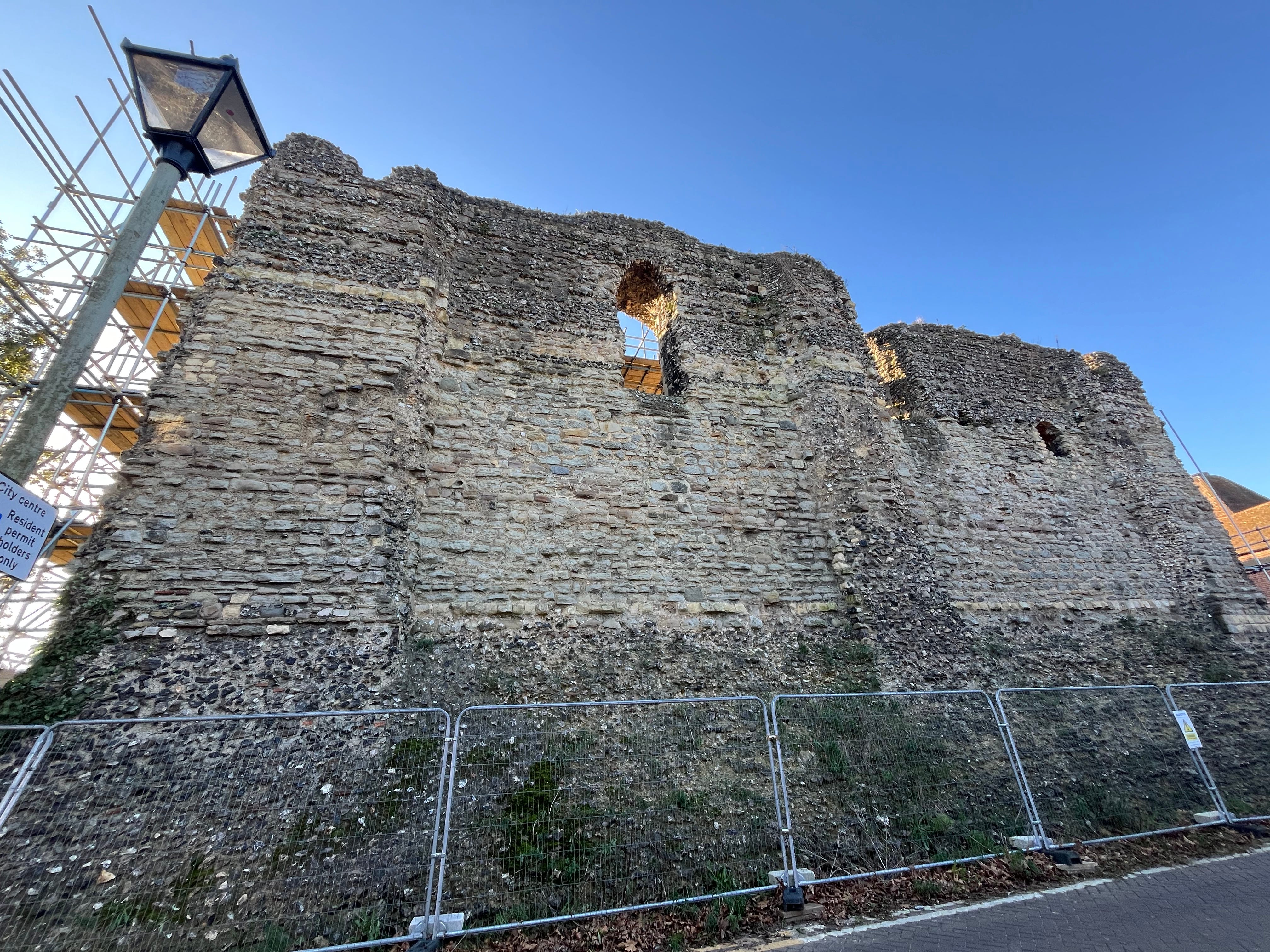
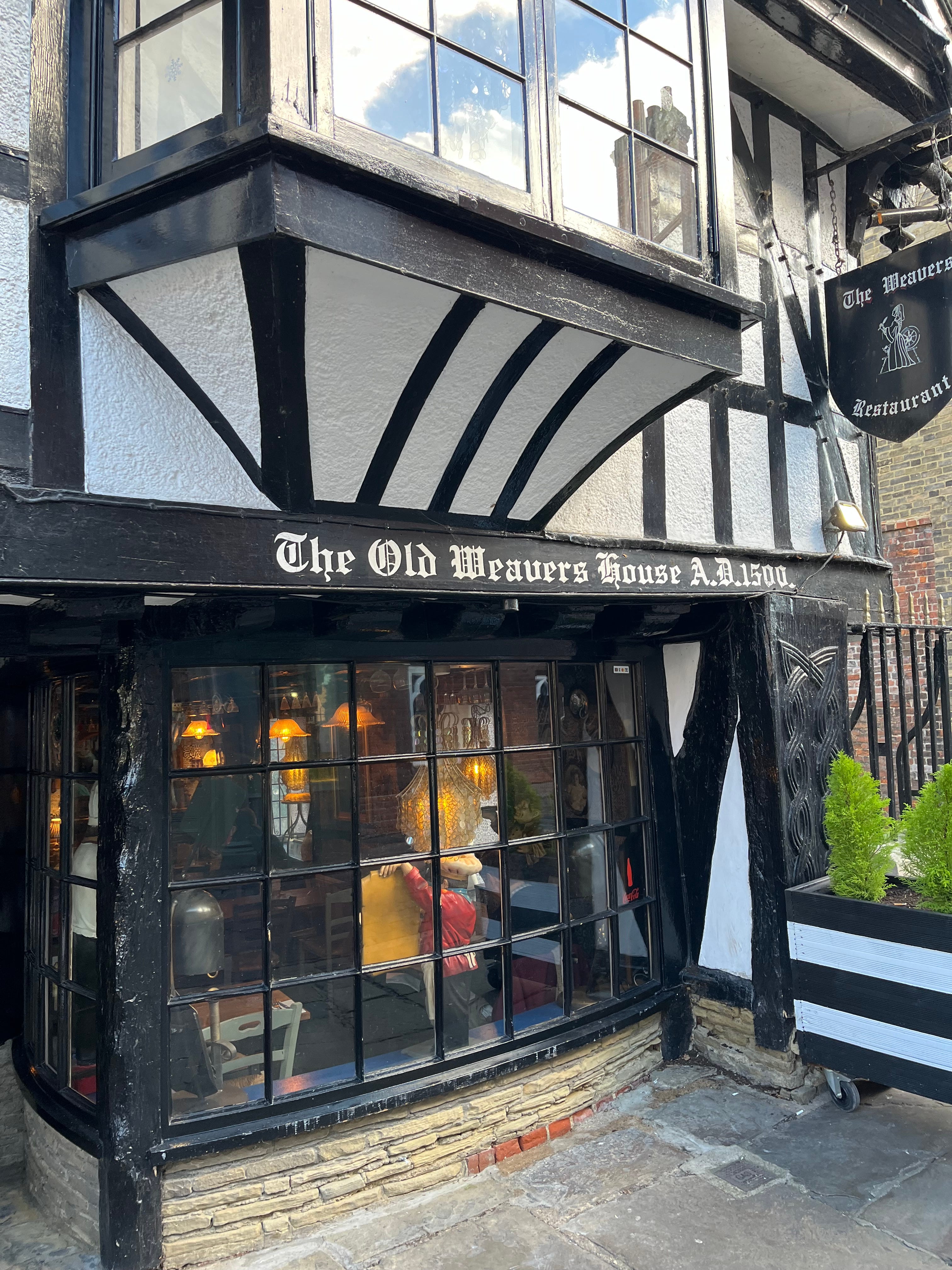
From there, it was a quick walk to the heart of town, with a brief detour at the ruins of Canterbury Castle, which is currently being repaired. I walked along the High Street for a while, and stopped at an old-looking restaurant for my first properly touristy meal of my sabbatical so far, a nice traditional roast beef meal.
Having feasted, it was into the Cathedral. The size and scope is difficult to convey in photos, but you might get some sense of just how massive this place is. After a nice chat with one of the assistants about the history of the place, I took my time walking the Cathedral, taking in the architecture and artwork. Much of the Cathedral's current structure dates from the late 12th and 13th centuries, and it bears all the hallmarks of Gothic architecture - the pointed arches, tall ceilings with overlapping support arches, massive stained glass windows. As the afternoon lengthened, the sun hit some of the western-facing stained glass windows and bathed the various chapels in magnificent color that really drove home the way these design choices were meant to invoke spiritual power and draw the mind to God.


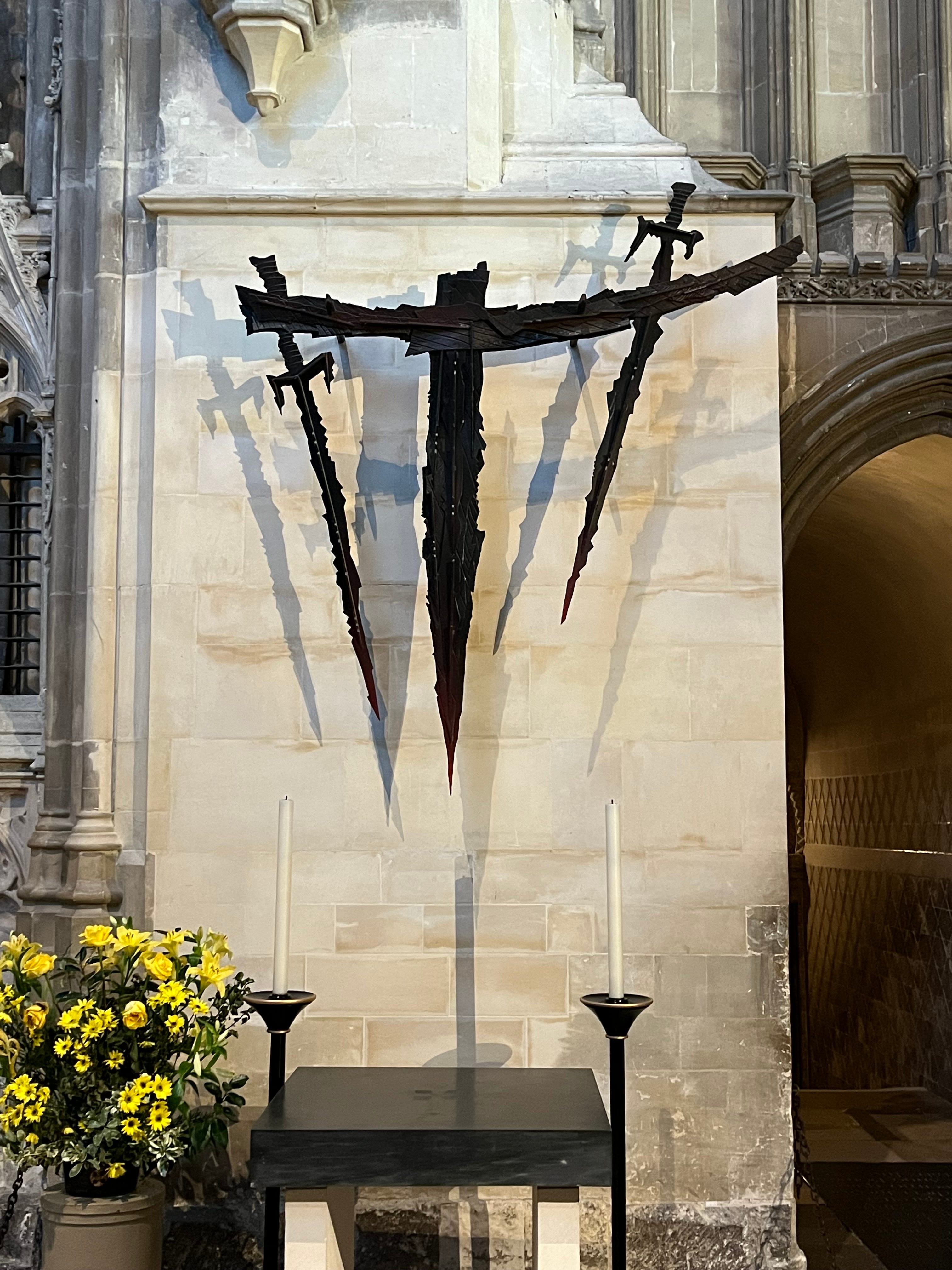
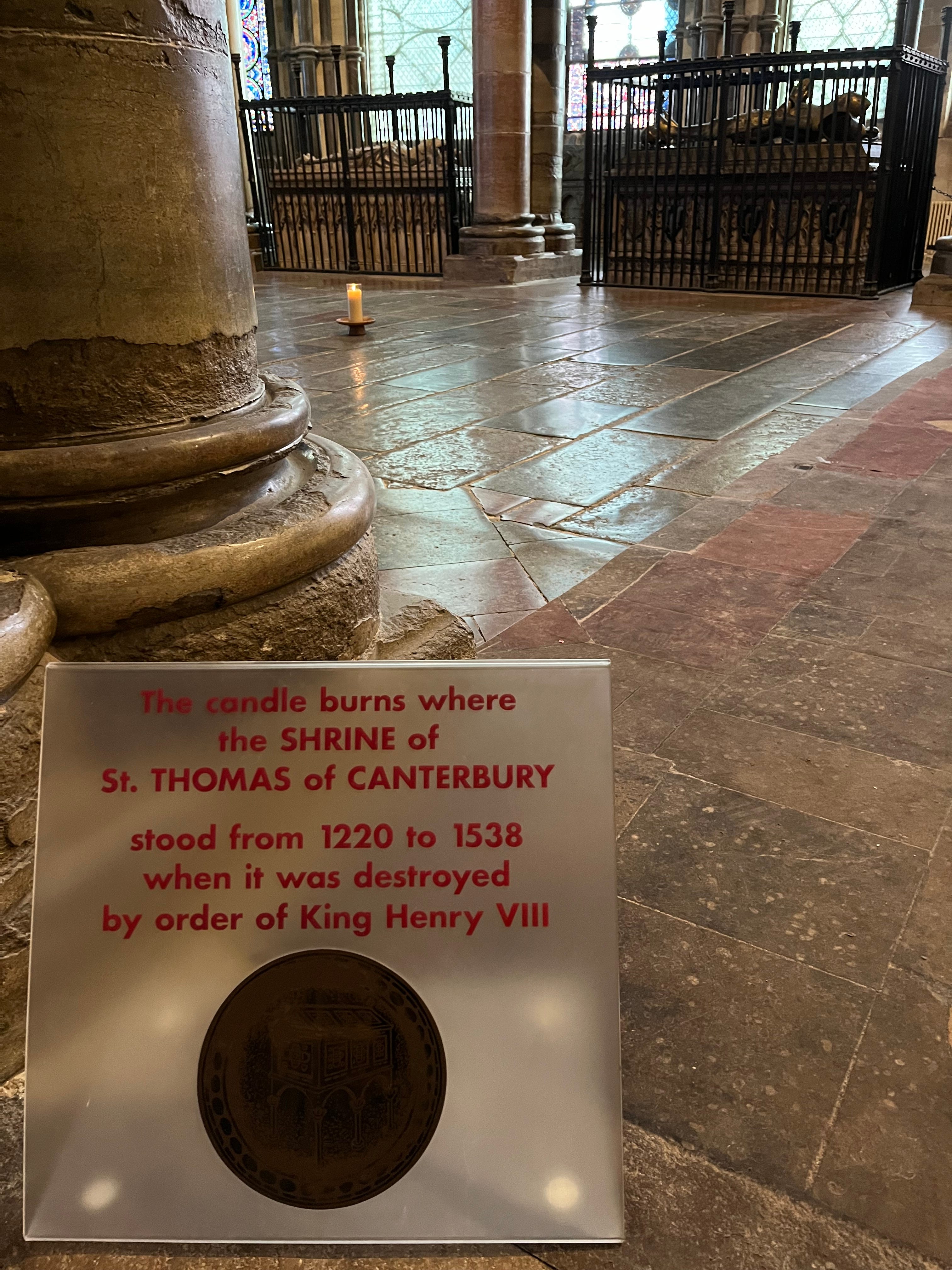
But of course, historian that I am, there were two other moments that impacted me most. First was viewing the monument erected at the site of Thomas Beckett's murder, a beautiful artwork of a frayed and jagged cross. Similary, towards the back of the Cathedral in the Trinity chapel there is a candle that stands on the spot where Thomas' grave once was (it was destroyed by King Henry VIII during the Protestant Reformation).
But most meaningful of all was a visit to the chapel of St. Anselm, which is where he is likely laid to rest. Anselm was the archbishop of Canterbury in the 1090s and the first decade of the 1100s, which means it's been nearly 1,000 years since he died, and much of the cathedral has been rebuilt in the time since his death, so the actual site of his burial is a bit up in the air. But Anselm, for the unfamiliar, was one of the great theologians and philosophers of the middle ages; he was the originator of the ontological argument for the existence of God, and wrote the first major work outlining the "satisfaction theory" of atonement (I will save the explanation of the ontological argument and satisfaction theory for another day).


Anselm, while deeply medieval, is an example of the kind of faithful Christian that rarely gets represented today: not just pious, but intellectual as well, a man who held faith and reason to be supremely compatible. I spent some time alone in Anselm's chapel, reflecting on his life and his faith. I'm not quite Catholic enough to have said a prayer to Anselm, but I think there's something to be said for holding up faithful figures from our history as exemplars, as guides of how to live the Christian life well.
Having made my tour of the Cathedral and grounds, it was time to head home. After a little more time spent walking around the center of town, I made my way back past the castle and the ancient walls to the train station. I watched the sunset over the Kentish farms and countryside as the train sped back to London.
So glad you finally got to go. Thanks for sharing the pictures. What an amazing place!